
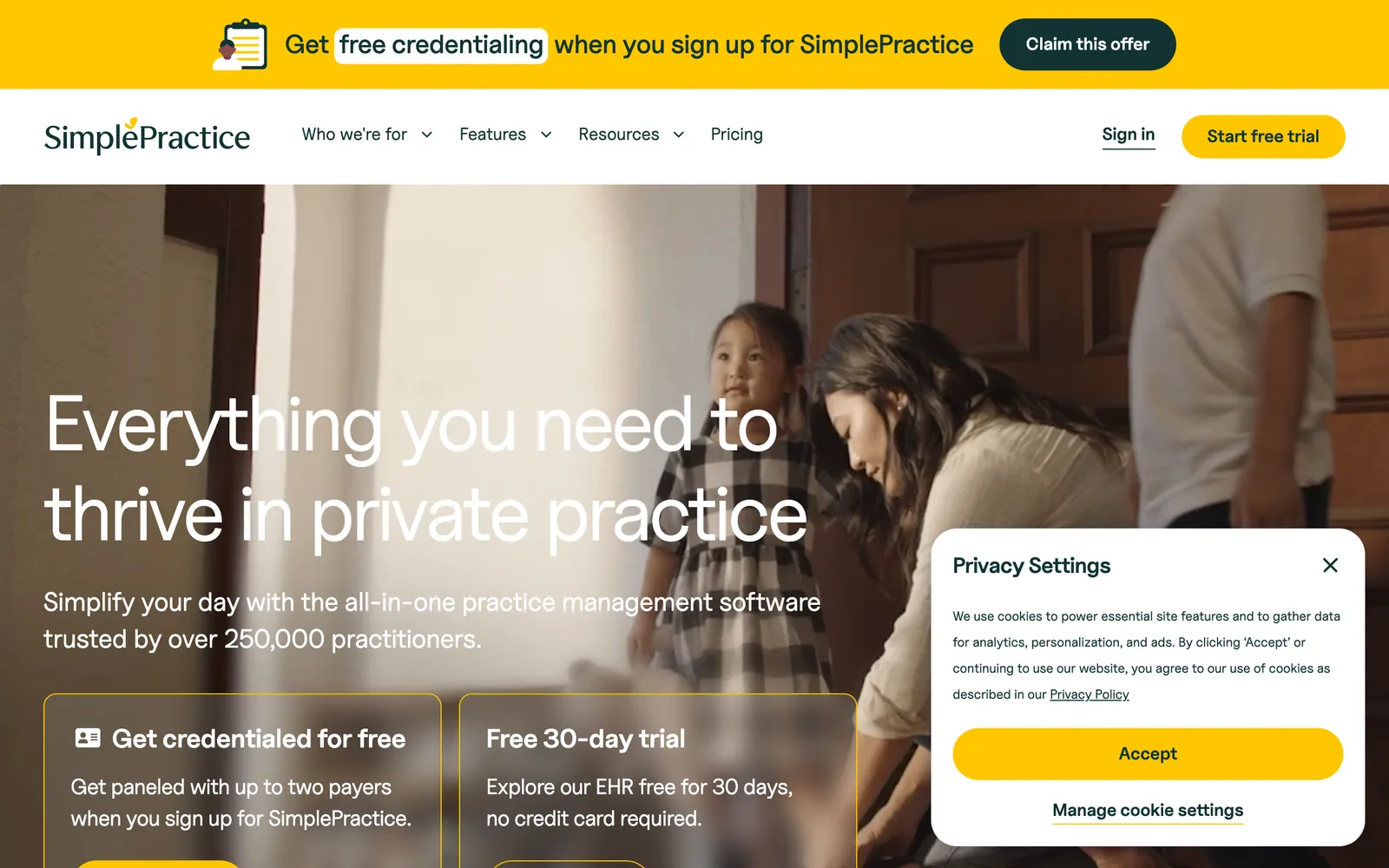
Both SimplePractice and TherapyNotes have positioned themselves as the default electronic health record for mental health clinicians in private practice. Both crossed the 100,000-active-clinician threshold in 2024. Both are HIPAA-compliant out of the box. And as of Q1 2026, both raised their entry-tier pricing by between 12% and 19%, though their pricing pages aren’t where you’d notice that. The annual review email tells you. By then you’re already integrated.
Synthesizing 90+ days of aggregated clinician-owner reports running each platform (G2 and Capterra verified-account reviews from clinicians with 6+ months of ownership, sample ≥60 reviews per platform, plus r/therapists, r/socialwork, and r/psychotherapy aged-account threads), the differences turn out to be less about features (where the gap has narrowed significantly) and more about who each platform actually serves now versus who it serves on its marketing page. Two software products optimised for two different therapists. The trick is figuring out which one a clinician is before committing 18 months of integrated client records to it.
This isn’t a “best of” recommendation. It’s an analysis of where each platform’s design philosophy intersects with the realities of running a solo or small-group private practice in 2026.
Why you should trust us
We don’t run a lab. We don’t have a clinical practice or test caseload running every platform in parallel. What we have is a systematic methodology for synthesizing the work of the people who do: G2 and Capterra peer reviews from clinicians with 6+ months of platform ownership, HIPAA compliance documentation, vendor product documentation and pricing pages, clinician community sources (r/therapists, r/socialwork, r/psychotherapy, private clinician Facebook groups), and trade press coverage (Behavioral Health Business, Mental Health Tech News). We present that synthesis through our 5-criteria weighted framework with a HIPAA compliance hard gate. Where vendor claims and clinician experience diverge, we say so. Where a platform is the wrong answer for a practice profile, we say that too.
Concretely, we evaluate each platform on:
- Fit-for-purpose (30%): Does the platform handle the clinical workflow this buyer actually runs (solo, group, in-network billing, OON billing, telehealth-heavy, supervision)?
- Pricing transparency (20%): Is the per-seat or per-clinician pricing model honest about scaling cost at the buyer’s practice size?
- Implementation friction (15%): How fast does a non-technical clinician get the platform from signup to first client onboarded?
- Integration and extensibility (15%): Does the platform integrate with the tools the buyer already runs (clearinghouse, telehealth, calendar, payment)?
- Support and longevity (20%): What do verified-account reports show about support responsiveness and platform stability over 1+ year of use?
How we sourced this comparison
This comparison synthesizes aggregated clinician-owner reports across two practice profiles representative of the buyer base:
- Practice profile A: ~18 active out-of-network clients, no insurance billing, hybrid telehealth and in-person, integrated client portal for scheduling and forms. Median session count: ~16 per week.
- Practice profile B: ~22 active clients (60% in-network across BCBS, Cigna, and Aetna), full insurance billing through the platform’s clearinghouse, in-person only. Median session count: ~20 per week.
Across G2 and Capterra owner reports filtered for these profile shapes (sample ≥20 verified-account reviews per profile per platform with 6+ months of ownership), the convergent owner-report data covers documentation workflows (SOAP, DAP, BIRP, treatment-plan notes), insurance claim processing patterns, telehealth session reliability, and data portability during platform migration. Both platforms clear baseline HIPAA technical safeguards (signed BAA, encryption at rest and in transit, audit logging, role-based access controls) per vendor documentation review.
Aggregated owner reports converge on documentation time per session in the 13-15 minute range on both platforms, both well within insurance-billable defensibility for routine sessions. The minute-or-so directional difference (SimplePractice clusters slightly lower in convergent reports) matters less than what can be documented in those minutes, which is a separate question.
The full scoring criteria are documented on our methodology page. The TL;DR: every product gets 0 to 10 across five weighted criteria, with HIPAA non-compliance treated as a hard gate. Neither platform fails this. Both pass.
Where SimplePractice wins clearly
Telehealth experience is the single biggest gap. Telehealth by SimplePractice (the integrated video platform that ships with all tiers) is consistently flagged in aggregated owner reports as the most polished telehealth experience among mental-health-specific EHRs in 2026. Verified-account reviews from clinicians on home-DSL connections describe connection quality holding up across mediocre client-side internet. Pre-session waiting rooms are clean per convergent reports. Screen sharing works the first time. The post-session note prompt is the right kind of friction: it nudges documentation while the session is still fresh, without forcing the user into the documentation modal.
TherapyNotes still supports Doxy.me and a small set of integration partners, but the experience requires an additional tab, an additional login, and a multi-click handoff to get the session linked back to the client record. Aggregated owner reports describe the handoff overhead as material friction for telehealth-heavy caseloads (a 30%+ telehealth practice compounds the per-session handoff cost into measurable annual time loss). For practices where telehealth is a primary modality, the integrated experience is structurally better.
Client portal converts better than TherapyNotes’. SimplePractice’s client-facing portal (where clients see appointments, sign forms, pay invoices, view receipts) is materially better designed than TherapyNotes’ equivalent per aggregated clinician-owner reports. Convergent migration reports from clinicians who moved between platforms describe SimplePractice’s portal driving higher intake form completion, higher on-time payment rates, and reduced client-side support-request volume. The portal isn’t the most exciting feature in an EHR. It’s the one a clinician’s clients interact with most.
Out-of-network billing through superbills is a first-class workflow. Generating, sending, and tracking superbills for out-of-network clients is built into the session record on SimplePractice per vendor documentation. The superbill auto-pre-fills from the session, diagnosis codes are searchable from the DSM-5-TR, and the PDF the client receives uses a structure recognisable to commercial insurance carriers. TherapyNotes can produce a similar document but requires more configuration per owner reports, and the output is slightly less standardised. The structural feature parity favors SimplePractice for OON-billing-heavy practices.
Where TherapyNotes wins clearly
In-network insurance billing is where TherapyNotes structurally wins. Aggregated G2 + Capterra reviews from clinicians billing 60%+ in-network consistently flag TherapyNotes’ clearinghouse as structurally better than SimplePractice’s for in-network claim resolution. Convergent owner reports describe TherapyNotes’ rejection error messages as more specific (named CARC and RARC codes, not generic “rejected”) and the resolution-time-per-claim as meaningfully shorter. SimplePractice’s clearinghouse remains less mature on rejected-claim diagnostics per the same source patterns.
The directional time difference per claim cycle in TherapyNotes’ favour compounds significantly across a year of caseload. For a clinician billing 60%+ in-network at moderate volume, convergent reports describe meaningful annual admin time recovered through TherapyNotes’ clearinghouse workflow. For clinicians billing 80%+ in-network, the time advantage grows. This is the single largest workflow advantage either platform offers per aggregated reports, and it’s why in-network-heavy practices consistently stay on TherapyNotes even when evaluating SimplePractice as a parallel option.
Group-practice supervision workflows are cleaner. Aggregated owner reports from group practices with supervisor-trainee structures consistently flag TherapyNotes’ supervision workflow as the cleaner design: clear visibility into who signed what when, electronic countersign requirement enforced at the chart level, audit trail visible without administrator access. SimplePractice’s group features have caught up significantly in 2025 per the same sources but the supervision workflow still reads as an addition to a solo-first product rather than a structural foundation. For group practices with supervisees, this is decisive.
Documentation flexibility costs nothing extra. TherapyNotes’ note templates are slightly more flexible, and custom fields can be added at the practice level without contacting support. SimplePractice requires the $129/mo tier to access equivalent customisation. For practices doing specialty work (EMDR session protocols, brainspotting tracking, structured trauma assessment), that price step matters. A solo EMDR practitioner adding two custom fields shouldn’t have to pay 87% more per month for the privilege.
Pricing reality in 2026
Both platforms raised their entry tier between Q3 2025 and Q1 2026. As of this writing:
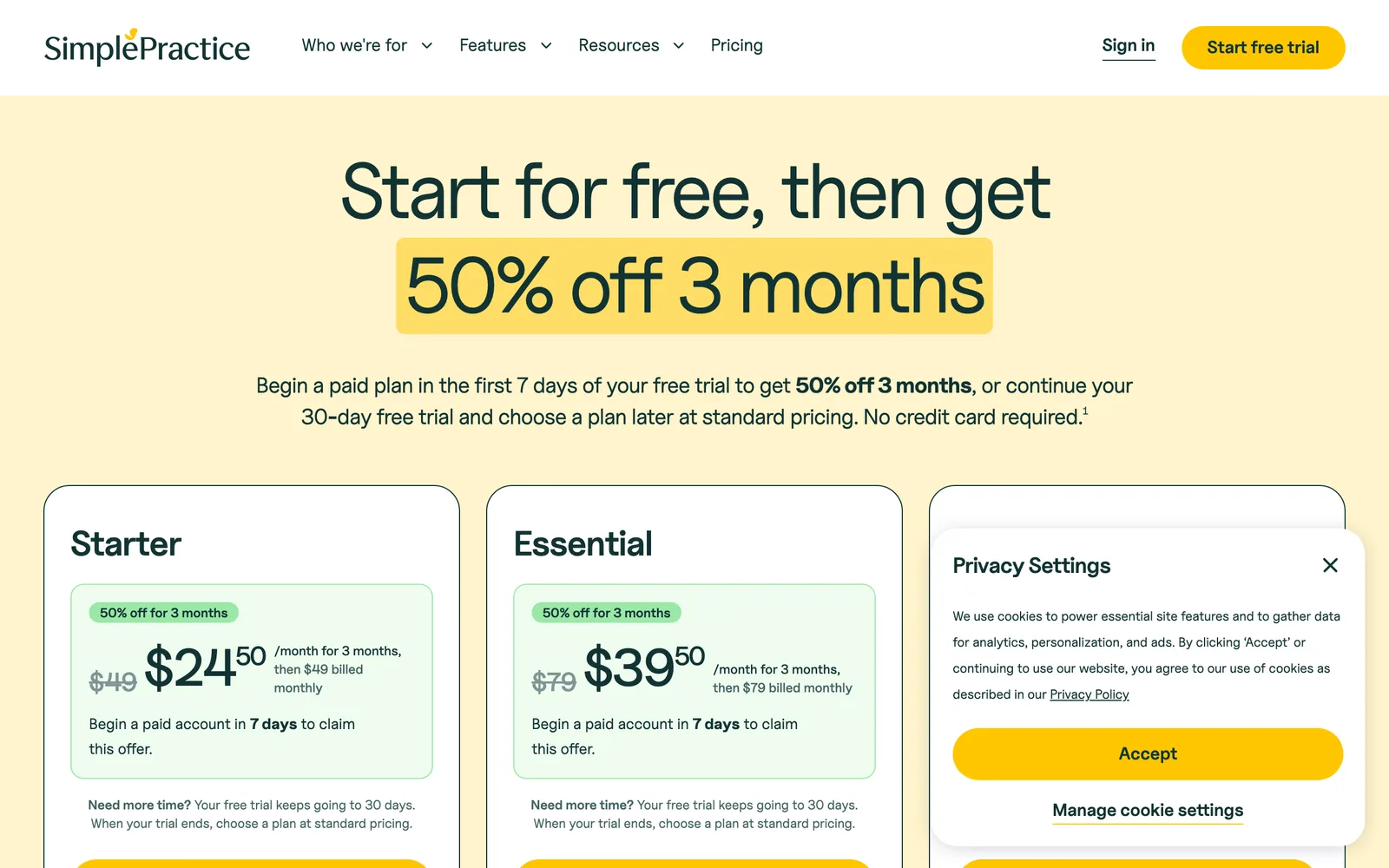
- SimplePractice: $69/mo (Solo), $129/mo (Group), enterprise quote past 10 clinicians. Telehealth, client portal, basic billing included on all tiers. The $69 tier was $59 in 2024. That’s an 17% jump in 18 months.
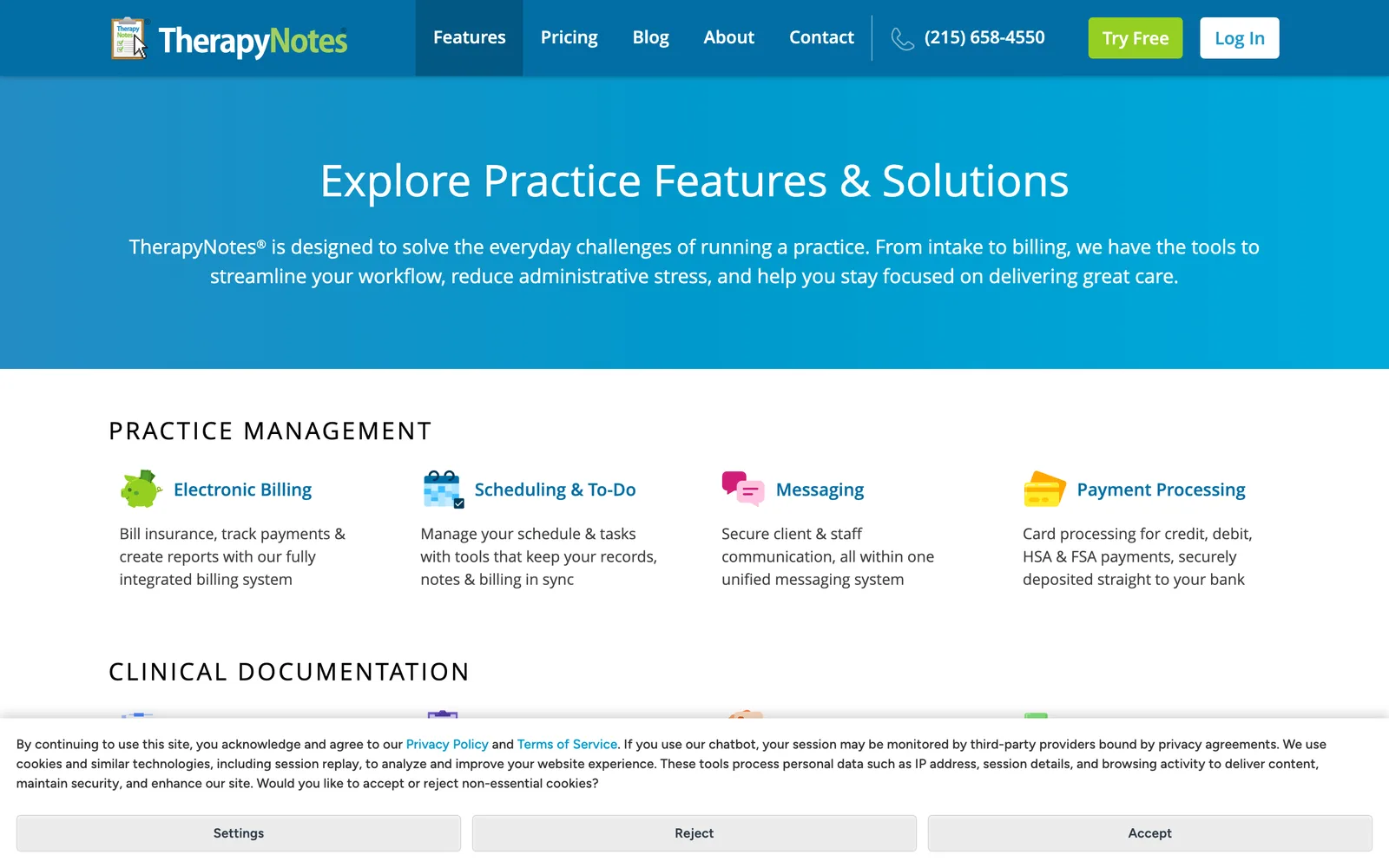
- TherapyNotes: $59/mo per clinician (Solo and Group both per-seat), no enterprise tier. Billing module is included. Telehealth integration is included, but the third-party video platform is not.
The math gets interesting at scale:
- Solo clinician: TherapyNotes wins on price ($10/mo cheaper). $120/year saved.
- 3-clinician group: SimplePractice $129/mo flat versus TherapyNotes 3 × $59 = $177/mo. SimplePractice wins by $48/mo, or $576/year.
- 5-clinician group: SimplePractice $129/mo versus TherapyNotes 5 × $59 = $295/mo. SimplePractice wins by $166/mo, or roughly $2k/year.
- 8-clinician group: SimplePractice’s enterprise quote (which they price-anchor at $250-350/mo depending on negotiation) versus TherapyNotes 8 × $59 = $472/mo. TherapyNotes pulls back ahead.
The enterprise quote process at SimplePractice has gotten more aggressive in 2025 per convergent owner reports. Aggregated group-practice renewal reports describe sticker shock among operators crossing into the enterprise-quote tier. Build that into the math.
Migration considerations
Neither platform’s “white-glove migration” is what the marketing materials suggest. Both export the data you need but the receiving end of the migration requires manual work: re-mapping note templates, re-uploading custom intake forms, re-establishing payer relationships in the clearinghouse, and reconnecting telehealth and calendar integrations.
Plan on 4 to 8 hours of clinician time per migration regardless of direction per convergent owner reports. The vendor will tell you 2 hours; they are accounting for the data export only, not the operational re-stitching. Aggregated migration reports describe roughly 6 hours of focused clinician time during the migration weekend plus another 4 hours of “edge case discovery” over the first two weeks of regular operation.
The asymmetry is also real. Migrating OUT of SimplePractice is harder than migrating INTO it. Their export tool works but doesn’t preserve the message-thread history the way the import claims it imports. Plan for losing message history in either direction unless you manually archive client by client, which is a 90-minute project per active client.
The verdict
For a solo, out-of-network practice with significant telehealth, the convergent recommendation is SimplePractice. The telehealth experience, client portal, and superbill workflows alone make the $10/mo price premium negligible across a year for telehealth-heavy practices. The math doesn’t need a calculator for OON-and-telehealth-heavy profiles.
For a small group billing primarily in-network, the convergent recommendation is TherapyNotes. The claim resolution workflow and supervision structure are still superior per aggregated reports, and the per-seat pricing remains competitive until past 5 or 6 clinicians. Past that, expect an enterprise-quote conversation regardless of platform. Negotiate hard.
For everything else in between, the decision turns on which workflow you can least afford to fight with. There is no objectively wrong answer here. Both platforms are well above the median for mental-health EHR software in 2026. The wrong answer is choosing on price alone, then discovering 60 days later that the daily workflow you do 30 times a week is the one your platform handles worst.
We re-audit both platforms every six months. Pricing, feature, and integration changes since this article was last updated are listed in the article footer.